
The Delhi high court on Monday granted bail to Jawaharlal Nehru University student Natasha Narwal, arrested last year in May in connection with the communal riots in north-east Delhi to perform the last rites of her father who succumbed to COVID-19.
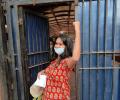
'Before entering Tihar jail, she told us not to worry and that we will together come out of this crisis soon.'

'She said she could have taken so much energy from her father had she got a chance to meet him before his death.'
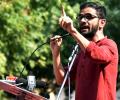
Activist Umar Khalid seeks bail in the UAPA case related to the 2020 Delhi riots, claiming lack of evidence and denying conspiracy charges. Other activists also argue for bail, citing delays and insufficient evidence.

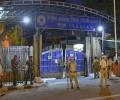
Student activists Natasha Narwal, Devangana Kalita and Asif Iqbal Tanha walked out of Tihar prison on Thursday, hours after a court here ordered their immediate release in the north-east Delhi riots 'conspiracy' case.
Additional Sessions Judge Revinder Bedi disposed of the application and asked the police to submit the verification report on the particulars of the accused and sureties by 1 pm on June 16.
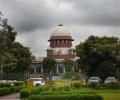
The Supreme Court denied bail to activists Umar Khalid and Sharjeel Imam in the 2020 Delhi riots conspiracy case, citing prosecution material suggesting their involvement in planning and strategic direction. The court granted bail to other activists but emphasized the seriousness of the allegations against Khalid and Imam.

Activist Sharjeel Imam has moved the Supreme Court challenging a Delhi High Court order denying him bail in a case linked to the 2020 Delhi riots. The High Court had denied bail to several individuals, emphasizing that conspiratorial violence under the guise of protests cannot be allowed.
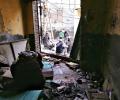
Delhi Police strongly opposes bail pleas of activists Umar Khalid, Sharjeel Imam, and others in the February 2020 riots case, claiming it was a pre-planned attack on the nation's sovereignty and an attempt to divide society on communal lines.

More than 500 scientists, academicians and students have written to the Bengaluru-based IISc expressing dismay over the cancellation of a discussion on anti-terror law UAPA that was to be led by student activists Natasha Narwal and Devangana Kalita.
The court granted her bail on the ground of parity as co-accused Jawaharlal Nehru University students and Pinjra Tod members Devangana Kalita and Natasha Narwal have already been granted the relief in the case.
Additional Sessions Judge Amitabh Rawat, who was scheduled to pronounce the order on Monday, posted the matter for Wednesday, saying it was not ready.
Student activists Devangana Kalita, Natasha Narwal and Asif Iqbal Tanha will remain in jail despite being granted bail by the high court here in the North East Delhi riots 'conspiracy' case as a lower court on Wednesday deferred its order on a plea for immediate release.

Kalita pleaded that she needed the videos and chats to prove her innocence, but the Delhi police counsel contended that her petitions were not maintainable.
The high court judgments will "not to be treated as precedent by any court" to give similar reliefs, the apex court said while hearing Delhi police's appeal against the bail granted to 3 Delhi students.
The high court directed Pinjra Tod activists Narwal and Kalita and Tanha to surrender their passports and not to offer any inducement to prosecution witnesses or tamper with the evidence in the case.

'You realised there was a struggle outside and now your struggle is to survive, live in prison, to retain your feelings, your humanity, and collectively continue doing inside what you were doing outside.'

The Supreme Court is scheduled to hear on Friday the appeals of Delhi Police challenging the Delhi high court verdicts granting bail to three student activists in a case related to the last year's communal violence in north-east Delhi during protests against the Citizenship Amendment Act (CAA).

The counsel pointed to two contradictions in Delhi Police's claims. Firstly, he showed the court a 21-minute video clip of Khalid's speech in Maharashtra, which the prosecution had allegedly labelled inflammatory.
The apex court had earlier expressed its displeasure over the high court discussing the entire anti-terror law UAPA in a bail matter and made it clear that the judgements shall not be treated as a precedent and may not be relied upon by any of the parties in any of the proceedings.
'From the look of those photographs and videos, it cannot be made available to anyone,' the judge said.
She has been booked under the anti-terror law in a case related to communal violence in northeast Delhi in February. Additional Sessions Judge Dharmender Rana granted the interim relief from June 10 to June 19 to Jahan on furnishing two sureties of Rs 1 lakh.
The high court's observation came while hearing the bail plea of Khalid who has challenged a trial court's March 24 order dismissing his bail application in the case.
According to the sources, those named in the chargesheet are Taahir Hussain, Mohd Parvez Ahmed, Mohd Illyas, Saifi Khalid, Ishrat Jahan, Miran Haider, Safoora Zargar, Asif Iqbal Tanha, Shahdab Ahmed, Natasha Narwal, Devangana Kalita, Tasleem Ahmed, Saleem Malik, Mohd Saleem Khan and Athar Khan.

'There are many people languishing in jail under these draconian laws, where it takes them 10 years, 15 years, to finally be acquitted.' 'And, who is going to account for those years?' 'The home ministry's statistics says that between 2016 and 2019, the conviction rate (under UAPA) is only 2 per cent and the use of UAPA has increased by more than 70 per cent.' 'There are many people languishing in jail under these draconian laws, where it takes them 10 years, 15 years, to finally be acquitted.'
'Who is going to account for those years?'
'The home ministry's statistics says that between 2016 and 2019, the conviction rate (under UAPA) is only 2 per cent and the use of UAPA has increased by more than 70 per cent.' 'The government statistics itself is so revealing what the purpose of this law (UAPA) is.'

The high court said "foisting extremely grave and serious penal provisions", engrafted under the UAPA, "frivolously" upon people would undermine the intent and purpose of the Parliament in enacting a law that is meant to address threats to the very existence of our nation.
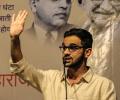
'It is very easy to invoke Bhagat Singh but difficult to emulate him... There was a gentleman who was eventually hanged .... He stayed there..., he did not run away. You are saying you weren't even there'
They have been accused of asking anti-Citizenship Amendment Act protesters to go to 'any extreme', spreading discontent in the community by calling CAA/National Register of Citizens anti-Muslim, and organise demonstrations to 'malign the image of the Government of India'.
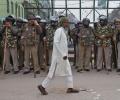
For this dispensation, ideas are dangerous. Those who propagate liberalism and democratic traditions are even more dangerous, observes Rashme Sehgal.

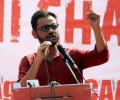
The anti-Citizenship (Amendment) Act protest was secular but the charge sheet in the Delhi riots conspiracy case was communal and the police fabricated a story to suit its narrative, former Jawaharlal Nehru University student leader Umar Khalid told a court in New Delhi on Tuesday calling it a 'naked form of false implication.'
In this conspiracy, firearms, petrol bombs, acid bottles and stones were collected at numerous homes, police claimed.

'We were activists when we were students. It was as students that we were propelled to fight for justice. Neither of us regret that.' 'Where the country is now, more and more people should become vocal.'

The Delhi high court was informed on Thursday that a trial court has ordered 'immediate release' from jail of Jamia student Asif Iqbal Tanha and Jawaharlal Nehru University students Devangana Kalita and Natasha Narwal who were granted bail on June 15 in the north-east Delhi riots case.
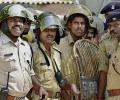
The high court on Tuesday had granted bail to two Jawaharlal Nehru University students Natasha Narwal and Devangana Kalita and a Jamia Millia Islamia student Asif Iqbal Tanha saying in its anxiety to suppress dissent, the State has blurred the line between right to protest and terrorist activity and if such a mindset gains traction, it would be a "sad day for democracy".
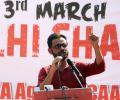
A bench of Justices Siddharth Mridul and Rajnish Bhatnagar was hearing Khalid's plea challenging a trial court's order which had on March 24 dismissed his bail application in the case.

The court further observed that Imam, also a former JNU student, and Khalid were stated to be 'co-conspirators' in the case and it would thus hear both the two bail applications together.
A Delhi court on Thursday denied bail to former JNU student Umar Khalid in a case of larger conspiracy in connection with Delhi riots during February 2020.
The Delhi high court on Tuesday refused to grant bail to former Jawaharlal Nehru University student Umar Khalid in a Unlawful Activities (Prevention) Act (UAPA) case related to alleged conspiracy behind the riots here in February 2020.
Advocacy against the law like the Citizenship Amendment Act (CAA) is not a crime, former JNU student leader Umar Khalid told a Delhi court on Monday, asserting that the police pressured the witnesses to give statements in the riots conspiracy case.
The Delhi high court Wednesday expressed its displeasure over the use of the term jumla by former Jawaharlal Nehru University student Umar Khalid in his criticism of the prime minister while delivering the speech.
